
scaling governancE
Establishing Design Operations for a 27-Subunit Ecosystem
U-M Standard Operating Procedure
about the project
Project Introduction:
The Division of Student Life at the University of Michigan houses 27 distinct subunits ranging from Adaptive Sports and Fitness to Michigan Dining and University Health and Counseling. My team was tasked with an immense challenge: completely redesign, reorganize, and rewrite all 27 web properties. The existing ecosystem was completely fragmented; split across legacy Drupal 9 setups, isolated WordPress instances, and Google Sites. The ultimate goal was to migrate this entire decentralized network into a single, cohesive, brand-aligned WordPress Multisite environment.
The Challenge:
When I joined the team, there were no modern web or product processes in place. The division had largely inherited a chaotic web ecosystem over years of decentralized updates, and there had been no major system-wide overhauls in recent history. Because our unit staff and content editors ranged from tech-savvy administrators to individuals completely untrained in web management, we faced a double-sided problem: (1) build a digital platform from scratch and (2) build the operational infrastructure to guide non-technical people through it without breaking the system.
The Solution:
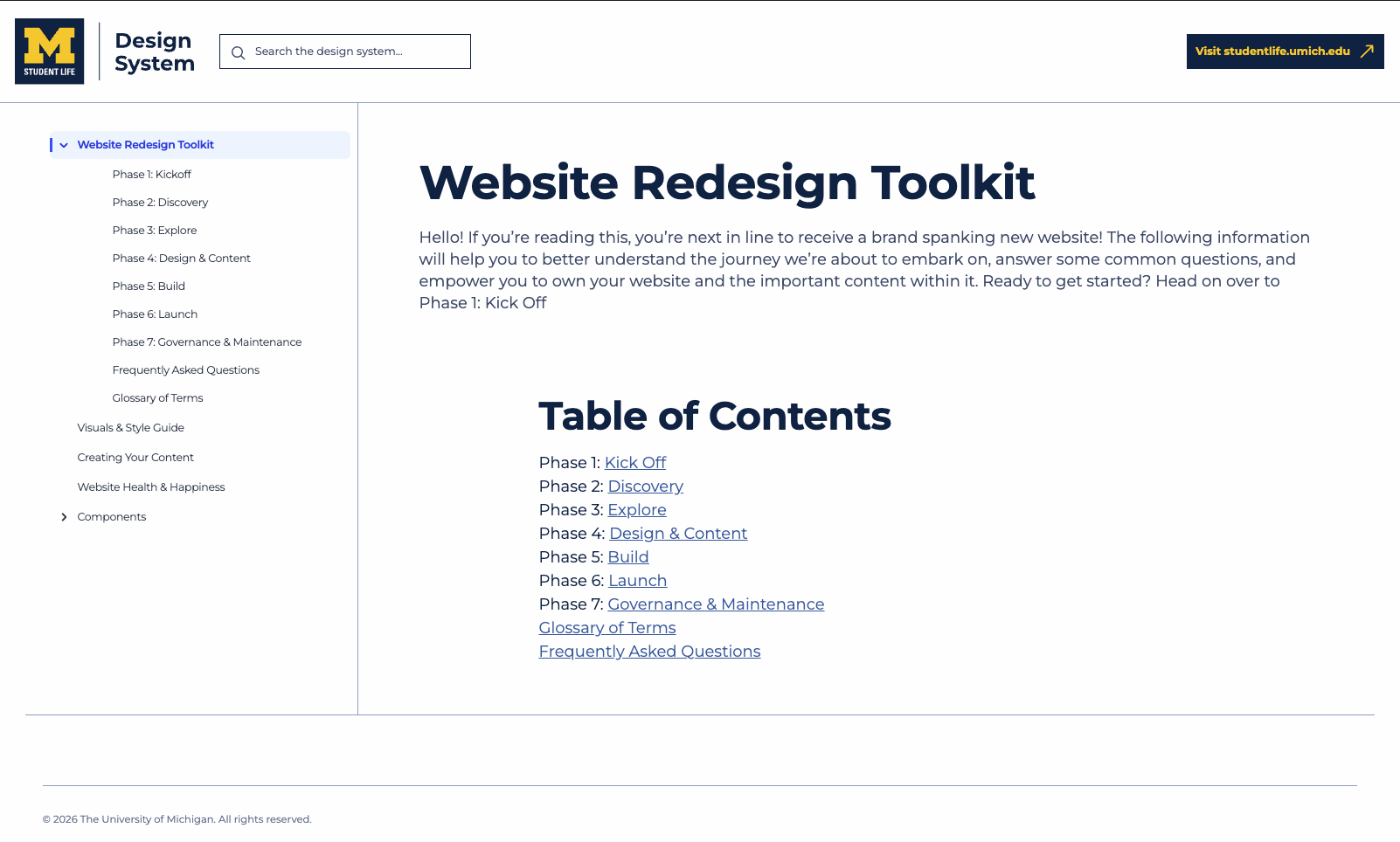
In addition to the 7-phase Standard Operating Procedure (SOP) I designed a companion Website Redesign Toolkit hosted on our documentation site. This toolkit translates complex enterprise design processes into plain, approachable layman's terms—effectively transforming our content editors from reactive users into proactive stakeholders.
The Blueprint: Engineering the 7-Phase SOP
To bring predictable structure to a multi-site rollout, I mapped out a rigorous 7-phase lifecycle for every single subunit site transition:
Phase 1: Kick Off
Reviewing the current legacy site footprint, assessing the unit’s specific goals, and defining the baseline project scope.
Phase 2: Discovery
Systematically reviewing all existing page copy, determining what content to keep, delete, or rewrite, and planning asset requirements.
Phase 3: Explore
Cleaning up historical navigation structures, eliminating isolated "island" pages, and building intuitive user sitemaps.
Phase 4: Design and Content
Applying our centralized Figma design system to the subunit's unique identity, creating custom wireframes and high-fidelity prototypes, as well as polishing and finalizing the copy.
Phase 5: Build
Utilizing our staging environment to build out layouts and input text, imagery, and components directly into WordPress templates.
Phase 6: Launch
Conducting final stakeholder sign-offs, onboarding the unit's local staff using our toolkit walkthroughs, and officially pushing the site live.
Phase 7: Governance & Maintenance
Establishing a governance and review cycle, where sites will be reviewed quarterly for content refreshes and accessibility or technical issues.
The Toolkit: Translating Tech into Human Language
A framework is only as good as the people who adopt it. Because getting distributed teams and copywriters to adopt modern web processes is an uphill battle, the Website Redesign Toolkit was designed as an absolute source of truth.
Jargon-Free Onboarding: It strips away intimidating technical vocabulary, replacing concepts like "component variance" and "information architecture" with clear, goal-oriented visual explanations.
Structured Intake & Feature Requests: It features an intuitive, standardized workflow for how unit staff can request new components or functionality from the development team without derailing the core design system.
Frictionless Governance Walkthroughs: It provides explicit style guides and guardrails so that distributed editors know exactly how to publish content without breaking brand standards or causing accessibility errors.
Validating the System
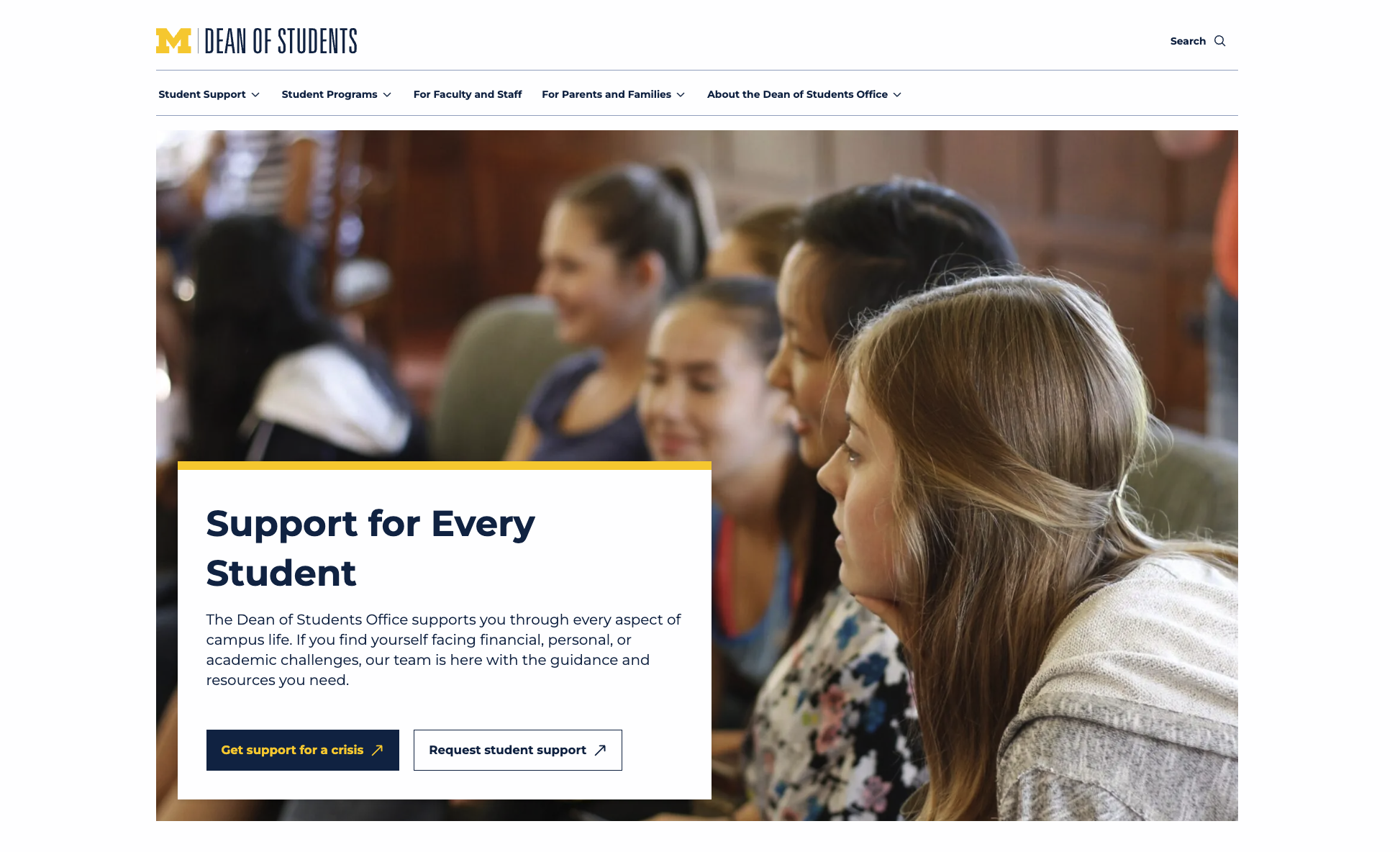
To stress-test this operational engine before a wide-scale rollout, we initiated a pilot rollout on the primary Dean of Students site. Implementing the 7-phase SOP and utilizing the Redesign Toolkit completely transformed our execution speed:
Smoother Cross-Functional Workflows: Standardizing our documentation immediately bridged the communication gap between our creative copywriters, design leads, and external development contractors.
Proactive Problem Solving: By deploying the framework on a live project, we successfully isolated and smoothed out process bottlenecks early, validating our intake mechanics and securing a highly efficient, predictable roadmap to scale across the remaining 26 subunits.